The Kennedy Park-Ionview Local Parks Plan: A Neighbourhood-Scale Analysis
As the Kennedy Park-Ionview area transforms from its suburban roots into a highly connected mobility hub, the City of Toronto’s newly released Local Parks Plan sets a 10-year roadmap for the 24 parks and 969 hectares defining this corner of Scarborough.
This analysis is based on the Kennedy Park-Ionview Local Parks Plan (November 2025), a strategic document released by the City of Toronto’s Parks, Forestry and Recreation division. The plan serves as a framework for capital improvements and parkland management within the study area over the next decade.
The Vision: Connectivity and Transit Integration
A major focal point of the plan is navigating the anticipated growth brought on by transit infrastructure improvements, including the Eglinton Crosstown, the proposed Eglinton East LRT, and the Scarborough Subway Extension at Kennedy Station. Eglinton Avenue East bisects the study area and serves as the primary gateway into the surrounding neighbourhoods.
To support this shift from a car-centric arterial road to an urbanized main street, the plan emphasizes making parks more accessible from Eglinton Ave E. This includes:
Active Transportation: Enhancing connections to City-wide trail systems, specifically linking local spaces to The Meadoway, Taylor Creek, and West Highland Creek.
Permeability: Prioritizing parkland acquisitions with street frontage and creating mid-block connections to break up large suburban blocks.
Key Priority Parks
The plan highlights four specific sites slated for immediate attention:
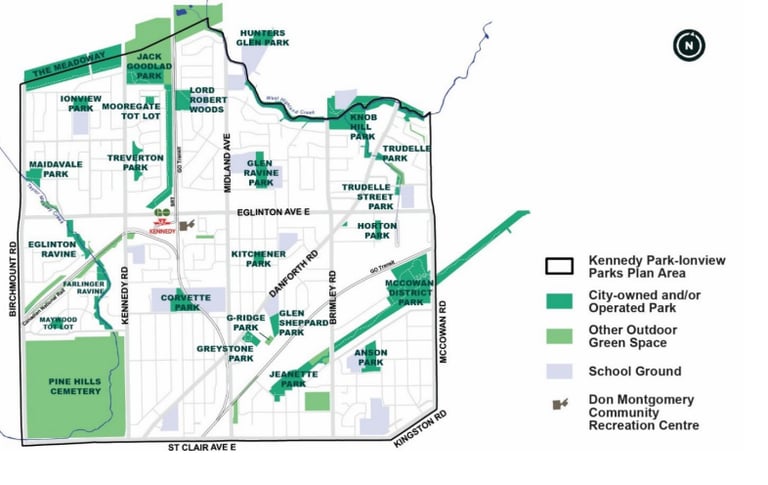
Jack Goodlad Park: Proposed opportunities include creating better connections to The Meadoway and expanding naturalized areas. The City is considering new amenities such as a dog off-leash area and multi-use courts for tennis and pickleball.
A Logical Review: Fundamentals and Follow-through
While the plan provides a solid framework, a professional review reveals areas where the "outcomes" feel more like a restatement of basic planning principles than new, site-specific innovations.
The "Baseline" Dilemma
The City spent from Fall 2023 to Fall 2025 gathering data and consulting over 800 residents. The groundbreaking conclusions!
However, many of the primary objectives, such as installing better wayfinding signage, providing ample shade and seating, and effectively illuminating pathways, are fundamental urban design principles. While it is a positive step to see these needs acknowledged, they represent the absolute baseline for functional public space. A logical question remains: why does a multi-year study conclude with "better signage" as a primary innovation rather than a pre-existing standard for a 969-hectare urban network?
Indigenous Placekeeping: From Intent to Implementation
The plan also stumbles in its approach to Indigenous placekeeping. While the City did host an Indigenous Community Workshop in April 2024, the resulting policy language feels hollow. The plan’s second primary objective states that "Specific ideas for indigenous gathering and ceremony that arise during the engagement and design process for new and improved parks in the area will be prioritized".
This is the bureaucratic equivalent of kicking the can down the road. Instead of embedding concrete, funded, and mapped Indigenous placekeeping elements directly into this 10-year vision, the plan simply defers the responsibility to future, park-specific consultations. It treats Indigenous inclusion as a theoretical future overlay rather than a foundational element of the Kennedy Park-Ionview overhaul. If the City wants to truly honour treaties and undo systemic erasure, it needs to move past box-checking workshops and commit to hard lines on the map.
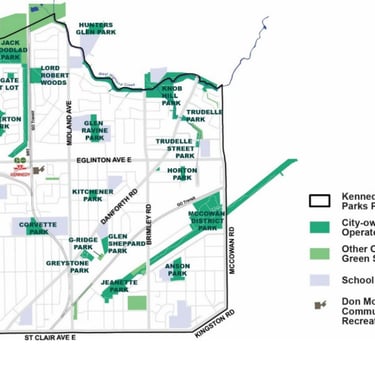
Image 1: Map of the Kennedy Park-Ionview Local Parks Plan, created by City of Toronto Parks, Forestry and Recreation in November 2025
References
City of Toronto. (2025). Kennedy Park-Ionview Local Parks Plan. Toronto: Parks, Forestry and Recreation. Prepared by the Park Development section in consultation with the Community Recreation and Indigenous Affairs offices.
https://www.toronto.ca/wp-content/uploads/2026/03/96b5-20260107-KennedyParkIonview.pdf
Corvette Park: This 2.5-hectare space is situated adjacent to the GO Transit railway. A highly anticipated improvement is the planned addition of a cricket pitch, with completion targeted for later this year.
Don Montgomery Community Recreation Centre: Located beside Kennedy Station, improvements focus on enhancing pedestrian circulation from Benjamin Blvd and Town Haven Pl to ensure safe navigation of the grounds.
Greystone Park: Located within the Gordonridge network, this park faces high heat vulnerability. Proposed upgrades include the basketball courts, splash pad, and an expansion of the Community Orchard.