East Willowdale in Focus: Land use, Demographic and History
In this post, we explore East Willowdale In this post, we explore land use, demographics, and transit, highlighting its evolution and future development.
Historical Development Overview
East Willowdale, part of the larger Willowdale area in Toronto, was first settled in the late 18th century by pioneers like Jacob Cummer. The area remained predominantly rural until the mid-20th century when post-war suburbanization led to significant residential development. The 1990s saw a trend of replacing smaller post-war houses with larger luxury homes, a phenomenon often referred to as the emergence of "monster homes.
Demographic
East Willowdale is a diverse neighborhood with 15,485 residents (2021) and a median age of 41.4. Immigrants make up 68.5% of the population, with major ethnic groups including Chinese, Iranian, and Korean communities. Common languages spoken at home include English, Mandarin, Farsi, and Korean. The neighbourhood has 6,045 households, with 29% being single-person households. With a median income of $40,800 and strong commercial activity along Yonge Street, East Willowdale is a vibrant, high-density community.
Land Use & Built Form
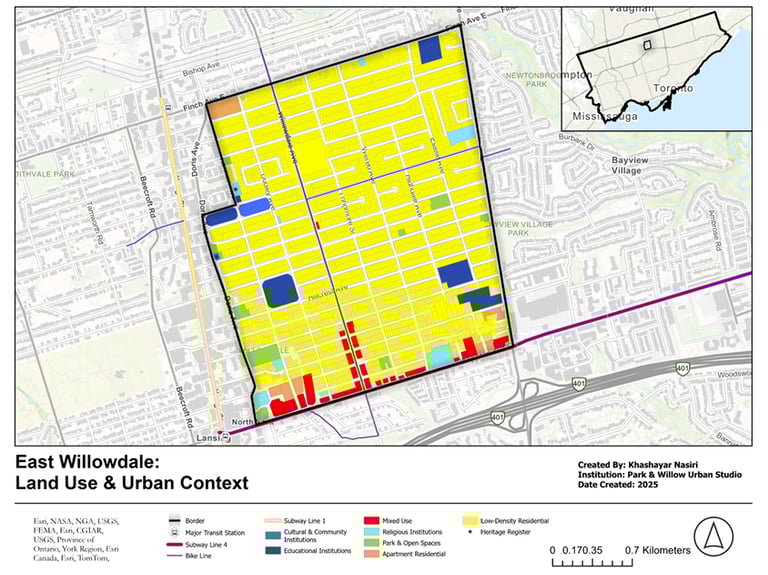
East Willowdale exhibits a diverse land use pattern, characterized by a mix of residential, commercial, and institutional spaces. The residential areas predominantly consist of single-family detached homes, interspersed with mid-rise apartment buildings. Commercial activities are concentrated along major corridors like Yonge Street, featuring a variety of retail establishments and office spaces. The built form reflects a blend of architectural styles, from early 20th-century designs to contemporary structures, illustrating the neighbourhood's evolutionary development.
Planning and Policy Context
East Willowdale falls under the jurisdiction of Toronto's Official Plan, which guides land use, growth, and development in the city. The area is subject to specific zoning bylaws that regulate building heights, densities, and land uses to ensure harmonious development. Recent planning initiatives emphasize enhancing public transit accessibility, improving public spaces, and promoting sustainable urban growth. The Sheppard Willowdale Secondary Plan outlines strategies for accommodating growth while preserving the neighbourhood's character.
Economic & Social Activity
East Willowdale boasts a vibrant economic landscape, with numerous small businesses, restaurants, and retail stores contributing to the local economy. The neighbourhood's proximity to major transit routes has attracted a diverse population, fostering a multicultural community. Social activities are centered around community centres, parks, and local events, which play a pivotal role in strengthening community bonds and enhancing the quality of life for residents.
Image 1 (Map): East Wiilowdale Land Use Map, created by Khashayar Nasiri in Sept. 2025
References
City of Toronto. (n.d.). Toronto Official Plan. City of Toronto. Retrieved from https://www.toronto.ca
Wikipedia contributors. (2024). Willowdale, Toronto. Wikipedia, The Free Encyclopedia.
https://en.wikipedia.org/wiki/Willowdale,_Toronto
Toronto Economic Development & Culture. (2023). Retail and Small Business Economic Profile. City of Toronto. https://www.toronto.ca